
Tenants gained nothing, while the richest Canadians made huge gains.
Federal policies that promoted real estate investment—and in emergencies, drove down interest rates—had a huge impact on pushing up the cost of buying a home since 1999. A recently published study showed that:
- The value of real estate wealth escalated faster than other forms of wealth, rising from 33 per cent to 42 per cent of all household wealth.
- Approximately 60 per cent of all the growth in real estate wealth went to the richest 20 per cent of households.
- The poorest 20 per cent did not benefit at all from real estate appreciation.
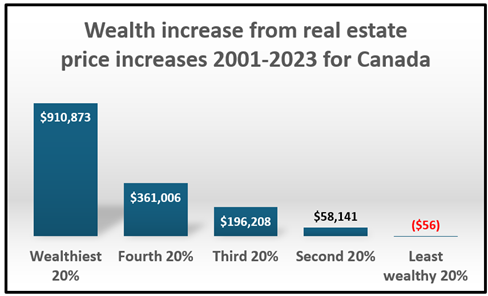 Starting with the 2008-9 financial crisis, Canadian housing prices have been among the world’s most expensive, and moved into the top spot with COVID. That made it harder for save for the down payment on a home, but added wealth for those who already owned. Accompanying those soaring housing prices were large increases in household debt, but on average, household net wealth—assets minus liabilities—grew faster. The chart shows the gains in average net wealth in 2023 for Canadian households, compared to what they’d have had if house prices had stayed at 2001 levels, for groups based on their wealth—that is, the wealthiest 20 per cent, etc.
In short, federal policies to respond to economic crises through lowering interest rates increased wealth inequality in Canada.