
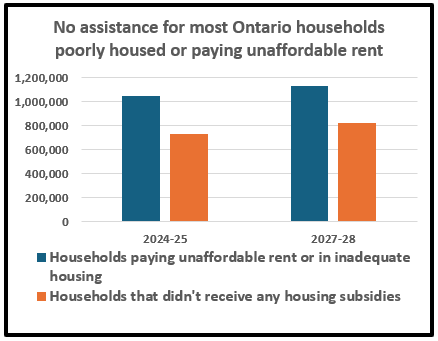
Ontario’s subsidized housing programs help less than a third of the Ontario households that pay unaffordable rents or live in adequate or overcrowded housing. And Ontario’s Financial Accountability Office (FAO) calculates that this will get even worse by 2027-28.
 The FAO defines a household as “in need of subsidized housing” if the household does not live in acceptable housing and cannot afford alternative acceptable housing, without subsidized housing support. Housing is considered unacceptable if it is in need of major repairs, it has an insufficient number of bedrooms for the household’s size, or its cost exceeds 30 per cent of the household’s before-tax income. (At one time, 20 or 25 per cent was considered the maximum percentage people should pay. The 30-per-cent figure was adopted in the mid-1980s as a way to reduce the number of households eligible for housing assistance by a third.)
Many of these households need housing subsidies because for at least two decades, landlords have raised rents far in excess of income growth.
In 2024-25, 1,045,263 households met this definition of need, yet 729,355 (70 per cent) received nothing and another 85,938 (8 per cent) received some subsidy but not enough to make their housing affordable.
By 2027-28, 1,132,394 households are expected to fit that definition of need. Of those, 817,572 (72 per cent) will not receive anything and another 76,442 (7 per cent) will receive some help but not enough to make their housing affordable.
The report covered the main subsidized housing programs, including the construction of below-market rent housing, rent supplements, rent-geared-to-income assistance and homeownership assistance. Homelessness and Indigenous programs are not included.
The report was purely for information and contained no comments or recommendations. You can read it here.