
That’s the conclusion of SingleKey, an organization that provides screening and other services to landlords, although it also has tenants as clients. In a detailed examination of rental data from across Canada in the third quarter of 2025, SingleKey concluded: 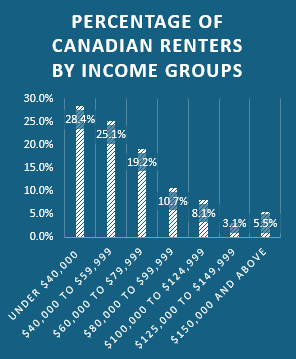
- “Despite regional income differences, renters across Canada face similar affordability pressures. Rent consumes about one-third of household income, and when combined with debt, many households are left with limited disposable income.”
- “High rents, not low incomes drive affordability gaps: While over half (53%) of renters earn under $60,000 annually, an increasing share fall into higher income brackets — with many earning well above $100,000. This shift points to a more affluent renter base overall, even as rent continues to consume roughly one-third of household income.”
Only affluent renters could afford most new rentals being built in Ontario, which since 2018 aren’t covered by rent controls Most renters have much lower incomes. More than a quarter of renters had incomes under $40,000, so they could not afford rent above $1,000 a month, hard to find in Hamilton or the GTHA. Another quarter could only afford rents between $1,000 and $1,500, again hard to find. Most of those renters can only afford their rent if they’ve been in a rent-controlled unit for a long time or had two good incomes.
We don’t have this kind of detailed information on tenants in Hamilton, but Rentals.ca data puts the Hamilton average for all units, in November, at $2,113, a bit above the national average cited by SingleKey of $2,063. Hamilton was 31st in Rentals.ca rankings, with Vancouver and Toronto area cities at the top, but Kingston, Sudbury, Burlington, Guelph, Ottawa, Waterloo and Barrie more expensive than Hamilton.
Here’s a summary of their data about renters, who make up about a third of Canadian households.
| Data | What’s going on? | |
| Median age | 32 | “Renting is no longer a short-term stage of life. The median renter is now between 31 and 33 years old, and about 20% of households have children. This signals that many renters are settling into long-term rental housing rather than transitioning to ownership.” |
| Tenants per units | 2 | “Shared income sources are essential for rental affordability: The average renter household earns $109K–$125K, roughly 35% more than the average personal income of $68K–$78K. This gap highlights how one-third of household income often comes from a second earner, making dual incomes, roommates, or co-signers the new reality of rental affordability.” |
| Average rent | $2,063 | The averages range from $1,623 in Quebec and $1,683 in the Prairies to $2,159 in Ontario and $2,490 in BC. |
| % of income spent on rent | 32.6% | Add debt payments to rent and 38.6 per cent of average personal income is used up, leaving limited income for everything else. |
| Pets? | 28% | |
| Children? | 11.7% | The proportion varies from 4.1 per cent in Quebec to 6.1 per cent in Ontario and 21 per cent in the Prairies. |
| Working? | 83.6% | 72.5% work full-time, 6.4% work part-time and 4.7% are self-employed. |
| Students? | 5.5% | |
| Retired? | 4.1% | |